


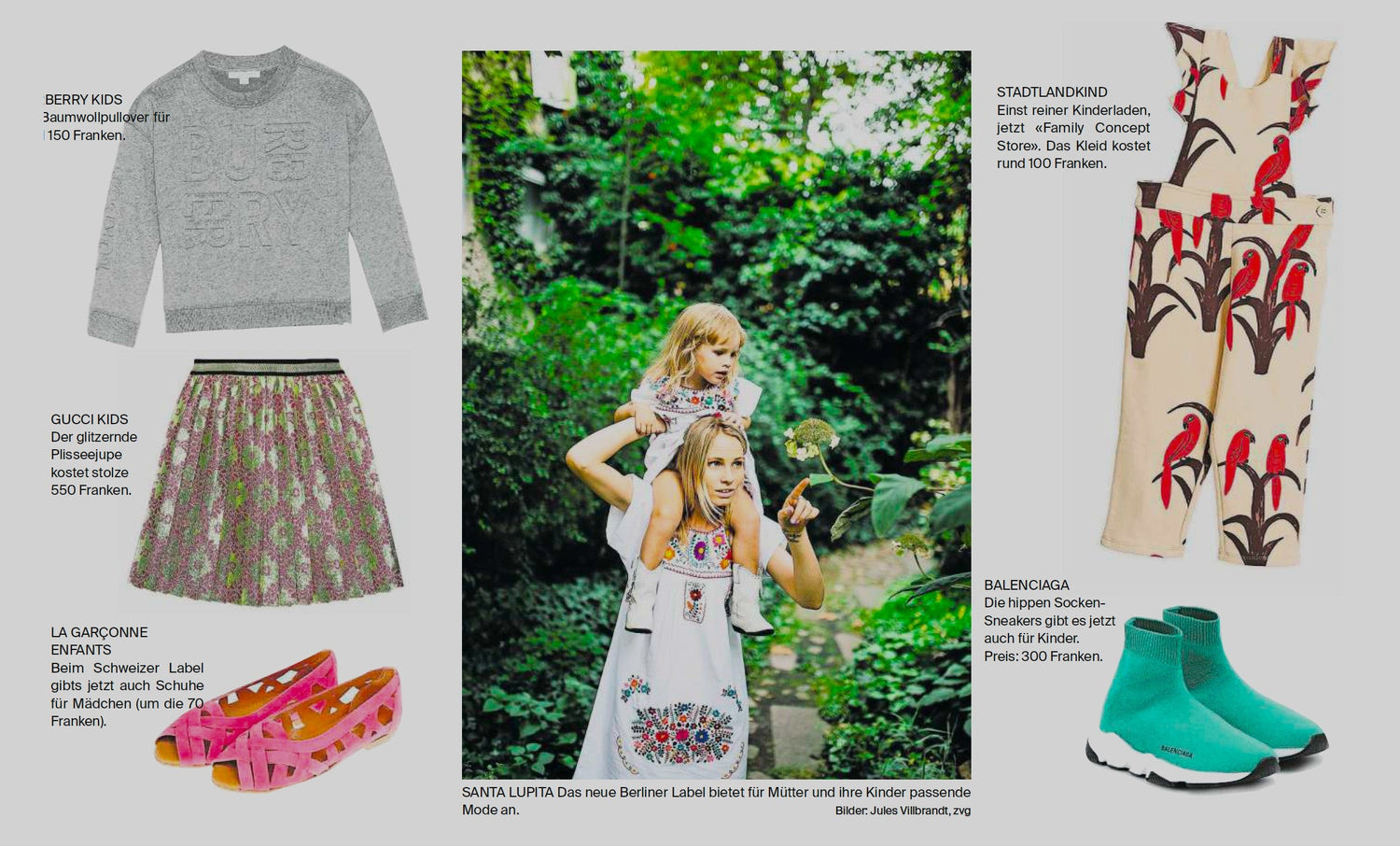
Luxury brands such as Gucci are now also designing for children and, conversely, children's fashion labels are dressing moms. The fashion industry has discovered the family that wants to be stylishly connected.
St.Galler Tagblatt
Saturday July 6, 2019
Diana Hagmann-Bula
Children love rain because it creates huge puddles in which they can bathe. Children cover themselves from head to toe in the sandpit. And why does watercolor only belong on paper? It's a wonderful way to embellish a T-shirt. A child's life is one big adventure. The opportunity to experiment is waiting around every corner. So here is the parental list of requirements for children's clothes: wash at 60 degrees Celsius.
washable, tumble-dryable, high-quality fabric, organic if possible, fairly produced, timeless in cut and color, comfortable, reasonably priced. And, admittedly, nice to look at too.
A dazzling pleated jumper for 550 francs? Doesn't really meet the requirements. In other words, anyone who lets their child bathe in puddles with it either has very tough nerves or a very tough family budget. The pleated jumper for 550 francs is from Gucci. The brand has recently started dressing not only adults, but also children. And with eye-catching, loud fashion. Lots of glitter, lots of logo, lots of price. Gucci children seem more likely to go to the opera than build castles in the sand. Balenciaga, Burberry and other luxury labels are following suit and are now also designing for the (noble) child. Haute couture for miniatures. The segment is growing so much that the German high-fashion online store mytheresa.com has decided to introduce a kids' category.
"The pronounced trend towards luxury in children's clothing is new," confirms Philipp Scharfenberger, lecturer in consumer behavior at the University of St. Gallen. On the one hand, he interprets the fact that parents spend so much money on their children's clothes as a sign of appreciation and love. "However, the demonstration of status often also plays a certain role." There is currently a trend towards perfection in almost all areas of life,
be it in terms of life balance, sport, nutrition and now also family outfits, says Scharfenberger. He considers luxury children's clothing to be particularly critical when it restricts the behavior of little adventurers and they are not allowed to dig in the sandpit with the others because the jumper cost 550 francs.
Look nice, but don't stand out
According to a US study, those who spoil their children in terms of fashion are raising the materialistic fashionistas of tomorrow. According to Scharfenberger, there is a danger that children will learn to associate feelings of love and appreciation with consumer goods. However, he also warns against falling into clichés. Dealing with the topic in the right way can also promote an understanding of values in children, for example: "They then understand that there are pants that are of higher quality than others and that you therefore need to take better care of them."
Fashion is also like wine: you usually start with simpler varieties and work your way up to more valuable ones as you get older. "If children start on a
high fashion level at an early age, this process is taken away from them. It is then difficult for them to develop further."
Where there is a market, there must be a demand. More and more parents are not only dressing themselves up, but also their children. After all, there are plenty of bloggers on social media showing how perfect family dressing works. Take Courtney Adamo, for example, an Englishwoman who has emigrated to Australia with her five children and her husband. In her photos, she always shows her entourage in lots of cotton, linen and knitwear, all in muted colors. And a beautiful backdrop, preferably a beach. And there are bound to be a few photogenic surfboards lying around somewhere. The pure promise of togetherness and freedom, staged so aesthetically that other parents want to imitate this lifestyle. And then they click through Adamo's online store.
The Englishwoman's sense of style is well documented: Time and again, she appears alongside Prince William with Kate, Charlotte and George or the Beckham clan in the list of best-dressed families. Nevertheless, Adamo is miles away from Gucci and Burberry. She represents the indie faction among parents.
For her, luxury means: Organic fabrics, sustainably produced, wide enough to do yoga in at sunset, in colors that soothe the soul. If she were Swiss, Adamo would probably buy from the Swiss online store Stadtlandkind. Co-founder Tobias Zingg describes his regular customers as design-, quality-, environmentally- and online-savvy. "Most of them like aesthetic, functional children's clothing, but they don't want to stand out." Of course, your own taste doesn't stop with the child. If the parents usually dress in classic colors such as blue, white and grey, they certainly don't send their offspring out into the world as a brightly colored bright bag in neon green and yellow. Underlining togetherness in a fashionable way So far, perhaps for professional photos for the family album. Now, however, the communal outfit for parents is becoming more and more suitable for everyday use. The Swiss label La Garçonne, for example, has recognized this development and no longer only offers shoes for women, but also for girls. The same model, only the size and price differ.
Fashion at eye level
The market also works the other way round: labels that previously only produced preppy clothes for the little ones are suddenly focusing on parents. For the time being, mainly on mom. Because in many families, despite increasing equality, she is still the one who goes shopping for the children. Stadtlandkind, which started out seven years ago as a children's store in the digital world, now calls itself a "family concept store". "Mothers can now also order a nice summer dress for themselves from us - in the same design as for their daughter if they wish," says Tobias Zingg. The aim is to "greatly expand" the family area in the near future.
Zingg and his team no longer differentiate between girls' and boys' fashion. Children's fashion, according to the website. "And with the trend towards twining, children's and adult fashion are becoming more and more alike," he says. Doesn't the partner look quickly come across as artificial and ridiculous in everyday life? "Fashion is a matter of taste," says Zingg, adding: "I want to wear the same Fairtrade sneakers as my son. Unfortunately, my feet are too big."
Fashion is known for its ability to reflect society. Perhaps the mini-me trend, as uniform clothing for big and small is called, is symbolic of education at eye level, which is currently en vogue. This is now being transferred to clothing. Fashion at eye level. Does it make adults look too childlike or children too grown-up?

