


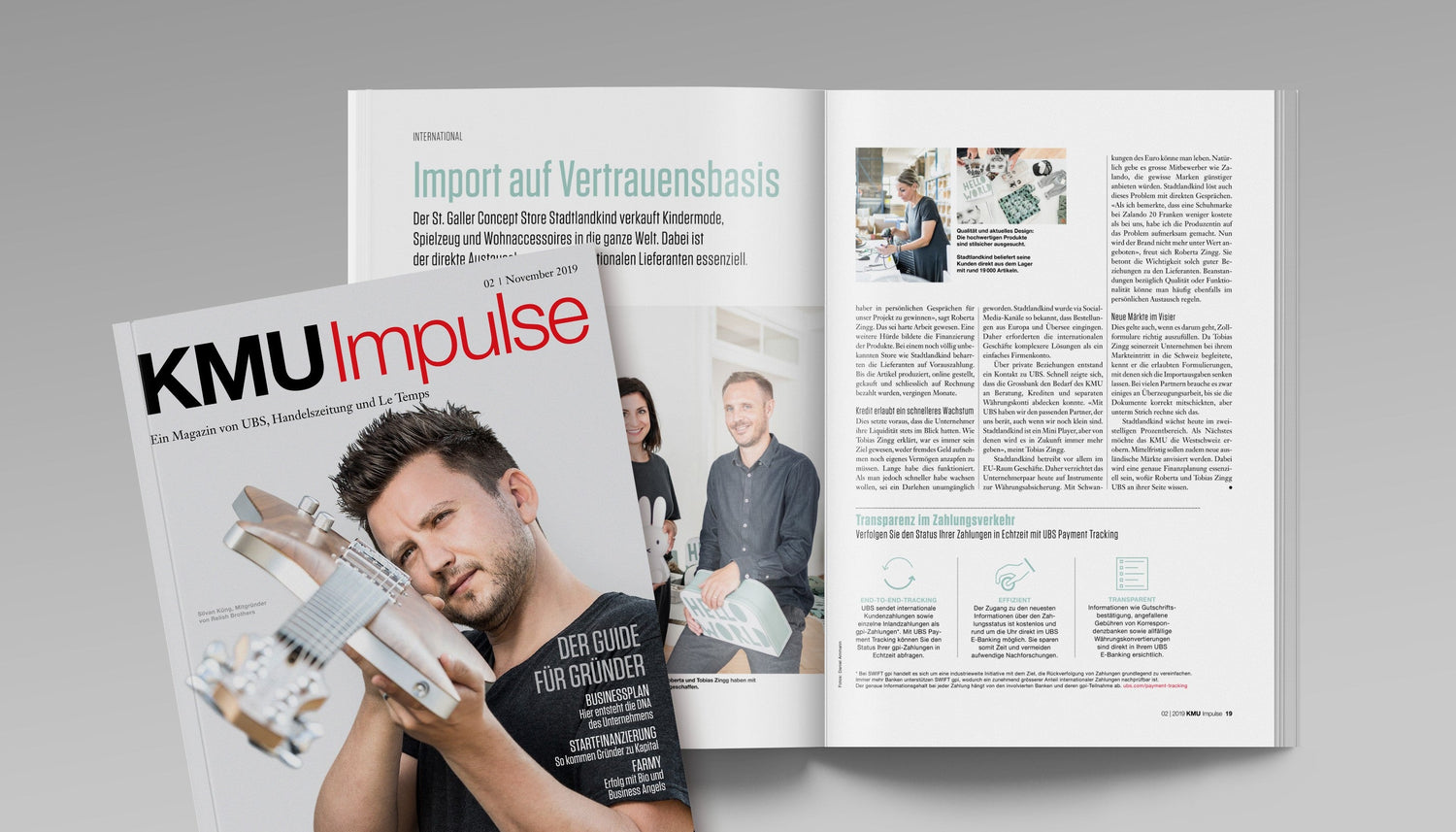
Personal contacts are essential, even for an online store. That's why Roberta and Tobias Zingg visit the most important international trade fairs for children's fashion and toys twice a year. There, the St. Gallen entrepreneurial couple meet the high-quality brands for Stadtlandkind. The former clerk and the e-commerce specialist have been working in online retail together with a couple friend for seven years. Thanks to the help of colleagues, acquaintances and relatives, the concept store was set up on a relatively small budget and now generates enough turnover to employ seven permanent staff and various freelancers. 19,000 items from small, exclusive production facilities are stored in the warehouse in Wittenbach in the canton of St. Gallen. They are located in Switzerland, Scandinavia, Southern, Western and Eastern Europe and America. According to Roberta Zingg, it was clear from the outset that the company wanted to focus on international suppliers. In Switzerland, the range of products that met the founders' high standards of design, organic, sustainability, quality, fairness and diversity was far too small.
Prepayment needs liquidity
As fashion collections have to be ordered around a year in advance, the main difficulty at the beginning was convincing foreign suppliers of a store that wasn't even online yet. "We traveled to the trade fairs with nothing in hand and tried to win the brand owners over to our project in personal meetings," says Roberta Zingg. That was hard work. Another hurdle was financing the products. With a completely unknown store like Stadtlandkind, the suppliers insisted on advance payment. It took months for the items to be produced, put online, purchased and finally paid for on account.
Credit allows faster growth
This meant that the entrepreneurs always had to keep an eye on their liquidity. As Tobias Zingg explains, his aim was always to avoid having to borrow money from others or tap into his own assets. This worked for a long time. However, when they wanted to grow faster, a loan became unavoidable. Stadtlandkind became so well known via social media channels that orders came in from Europe and overseas. International business therefore required more complex solutions than a simple company account.
Stadtlandkind mainly does business in the EU. This is why the entrepreneurial couple does not use currency hedging instruments today. They can live with fluctuations in the euro. Of course, there are major competitors such as Zalando, who offer certain brands at lower prices. Stadtlandkind also solves this problem with direct discussions. "When I noticed that a shoe brand cost 20 francs less at Zalando than here, I drew the producer's attention to the problem. Now the brand is no longer being offered below its value," says Roberta Zingg happily. She emphasizes the importance of such good relationships with suppliers. Complaints about quality or functionality can often also be resolved in a personal exchange.
New markets in sight
This also applies when it comes to filling out customs forms correctly. As Tobias Zingg accompanied companies entering the Swiss market at the time, he knows the permitted formulations that can be used to reduce import costs. Although many partners need a lot of convincing to send in the correct documents, the bottom line is that it pays off. Stadtlandkind is currently growing at a double-digit percentage rate. The next step for the SME is to conquer French-speaking Switzerland. In the medium term, new foreign markets are also to be targeted. Precise financial planning will be essential.
Excerpt from the interview with Denise Weisfolg on behalf of UBS Switzerland

