


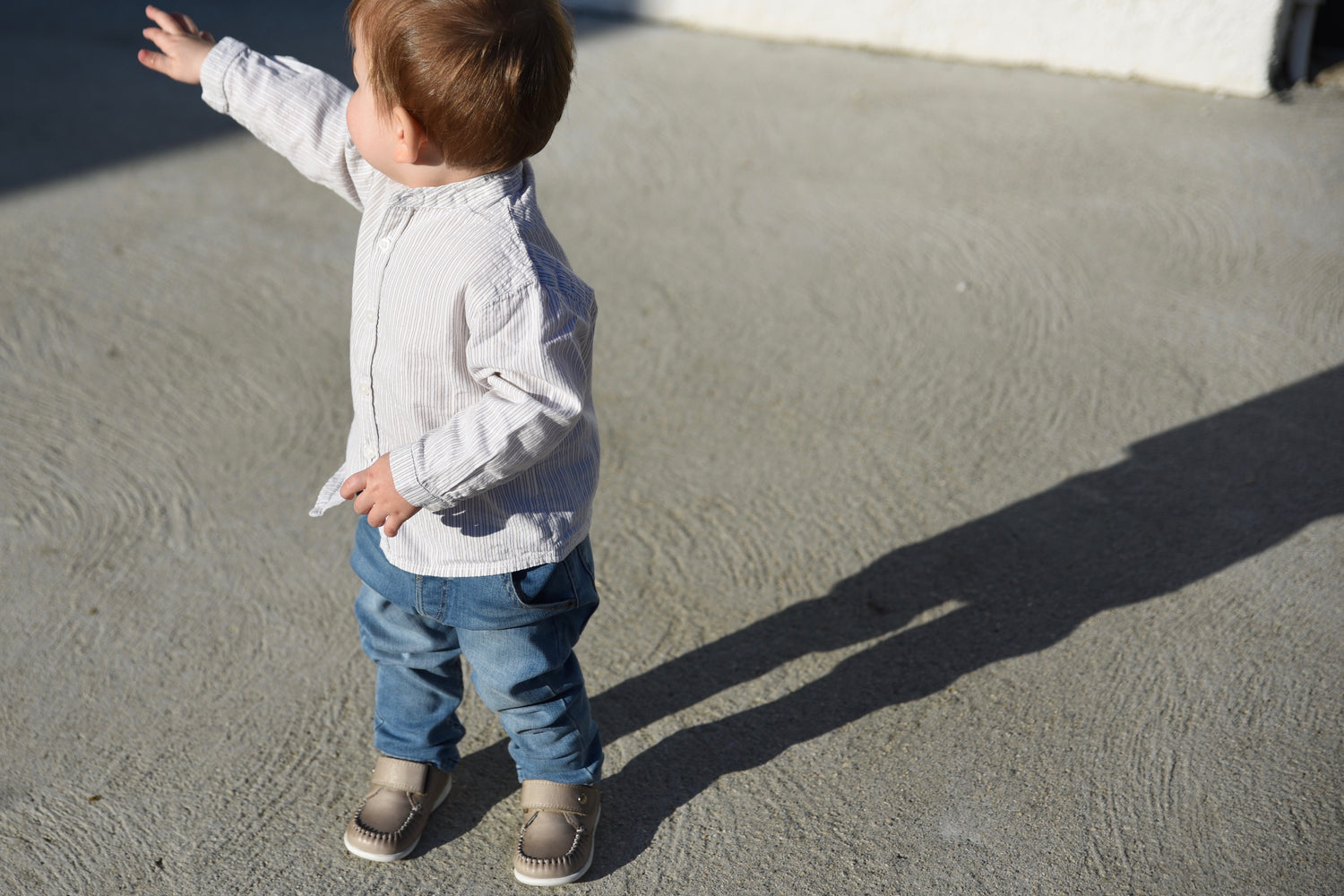
We put this question to our Swiss label for children's shoes. Christian Bagnoud, one of the fathers behind Benjie of Switzerlandgives us interesting insights into this important development of the toddler and reveals what you should look out for when buying your first shoes.
When does a toddler generally take their first steps?
"First steps" is a generic term that refers to several phases between 12 and 18 months. After around 12 months, the child can stand up without support. This leaves both hands free, which opens up many new possibilities. Some children can walk on their own, others only need to hold a single finger from their parents to walk.
At an average age of 14 months, the child can walk alone, but his gait is not yet very secure. To ensure stability and balance, he walks with his legs wide apart and his arms stretched out like airplane wings. Then he gradually begins to swing his arms. Once started, it sometimes has difficulty slowing down or stopping to avoid an obstacle.
At around 18 months, it walks with confidence. His legs are a little less spread out and he uses his arms less to keep his balance. His pace accelerates: he walks faster and jogs with quick, jerky steps at the limit of the race."
(Note: these ages are theoretical to give an idea of the progression, but are individual to each child).
What needs must be taken into particular consideration in the manufacture of children's shoes during this learning-to-walk phase?
"In this first walking phase, the child needs to gain stability and balance. At the same time, it needs flexibility to accelerate its pace and start walking independently."
So which shoe is suitable for my child to learn to walk in?
"Baby walker shoes provide stability and balance. That's why our Benjie First Step shoes have a real first insole. Very flat, it provides good stability for the child. There is a semi-rigid support at the heel that allows the foot to be held in its axis of propulsion. At the same time, the shoes must be flexible. Our First-Step shoes are soft and flexible so that the foot can unfold perfectly. This flexibility "forces" the child to find its own balance. In addition, our soles are very thin for the first step, which makes the shoe soft and very light."
Text: Roberta Zingg

