


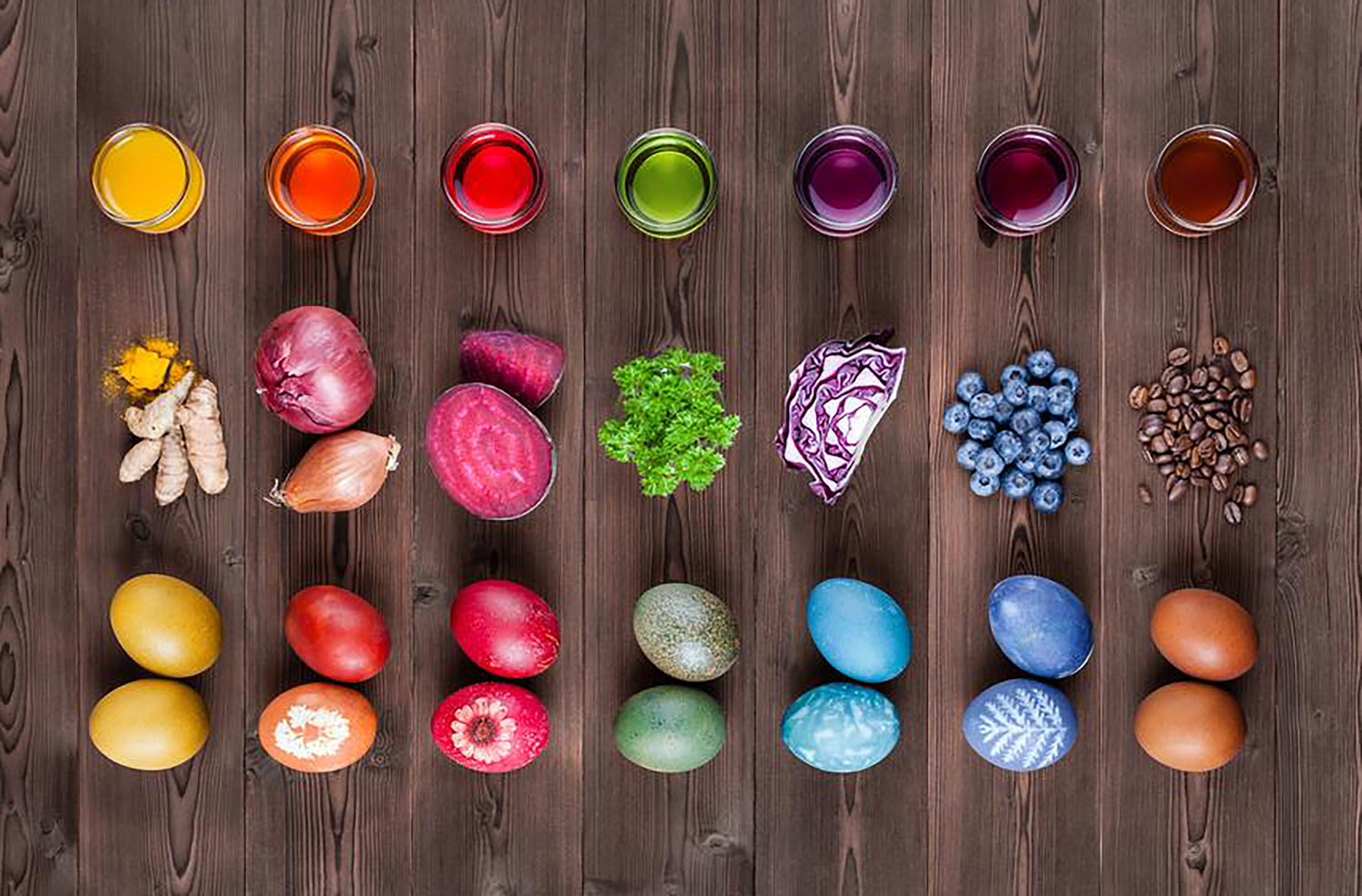
Colorful eggs and Easter have been closely intertwined for centuries. Because people in the Middle Ages during the Lent not only meat but also eggs during Lent, many eggs accumulated until Easter. The eggs were preserved by boiling them, often on Holy Saturday, the so-called "dyer's Saturday". Coloring eggs also had a purpose, as the color helped to distinguish the boiled eggs from the raw eggs. The German physician and botanist Georg Franck von Franckenau reported as early as 1682 in his book "Satyrae" that the dyed eggs were also hidden so that children could search for them.
In the Middle Ages, however, there were no synthetic colors to give eggs a colorful coating. Farmers used fruit, vegetables, parts of roots and onion skins to dye eggs. Even today, you can confidently do without chemicals, as nature provides enough dyes for this. Coloring eggs naturally is a great experience for children. They are often amazed at the coloring power of plants.
It is best to work with white eggs. White eggs take the color much better than brown eggs, especially if you rub them briefly with damp kitchen paper and a little vinegar before dyeing. The vinegar degreases the shell so that the color pigments adhere better and more evenly. Regardless of whether you dye beetroot, spinach or onions, the color results are not bright, but soft and pastel.
To dye Easter eggs with the natural substances, boil the dyeing materials in a liter of water to make a so-called brew and leave them to infuse for a quarter of an hour.
Now place the eggs in the brew. How long is up to you. Observe how differently brown and white eggs take on the color. Eggs that have just been hard-boiled and are still warm usually take on the colors best.
If this is too hectic for you, you can also leave the eggs and stock to cool and simply leave the eggs in the stock all day or overnight.
If monochrome is too boring for you, nature has another great trick for conjuring up patterns on Easter eggs: you can use the acids in vinegar and lemon juice to etch away the top layer of color! Simply apply patterns with a cotton bud and the most amazing patterns will appear!
The longer the acid is left on an area, the lighter it becomes. Sounds dangerous, but it's completely safe. And of course the eggs remain edible.
You can find even more Easter inspiration on our Pinterest board:
https://www.pinterest.ch/stadtlandkind/easter/
Cover picture: rock_the_stock/Fotolia

