


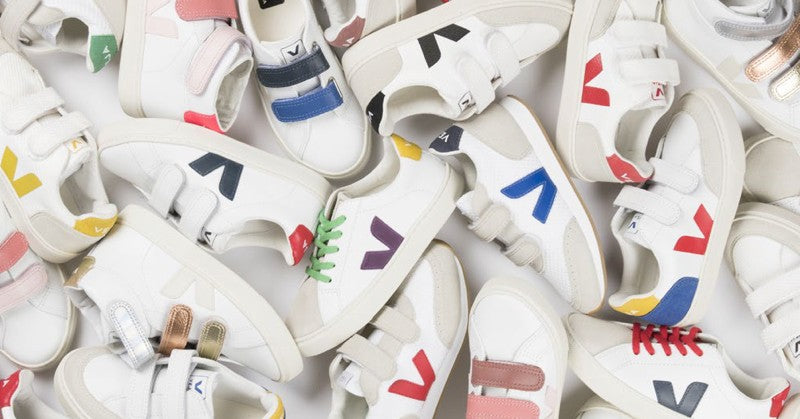
"Look" - that's what VEJA means in Portuguese. And that's exactly what Sébatien François-Ghislain, the founders of the sustainable sneaker label VEJA, want to achieve. That we look at how a sneaker is produced.
The two school friends Sébastien and François-Ghislain set off in 2004, with just 5,000 euros in start-up capital, to find cotton cooperatives in northern Brazil for the production of fair canvas fabric. They only wanted pure natural rubber for the soles of their sneakers and therefore visited the Amazon region of Acre.
The two friends also used their stay in Brazil to calculate the exact price they wanted for their VEJA sneakers. So that the people who produce the raw material and the shoe are paid fairly.
To this day, the now world-famous and high-quality fairtrade VEJA sneakers are produced in Brazil based on this knowledge. The production costs of a VEJA sneaker are around five to seven times higher than those of a sneaker from another well-known brand. Veja pays the farmers around three times the world market price for their organic cotton, for example. How does this work? No advertising and no overproduction. This means that VEJA can put all the money into the production costs of the shoes, use sustainable and ecologically sound materials and pay its workers fair wages.
VEJA sources its leather from Uruguay - where no virgin forest is cut down for the cattle farms, and it is tanned with acacia extract without any added chemicals. All steps in the production chain, from the cotton harvest in Ceará to the headquarters in Paris, are certified by the independent international certification company Flo-Cert.
Transportation is also as sustainable as possible: VEJA sneakers are shipped to Le Havre in recycled cardboard boxes and then on to Paris. VEJA receives a further sympathy bonus from us for the external logistics: it is operated by the organization "Sans Frontiers", a project that reintegrates unemployed addicts.
We are avowed VEJA fans - and you?
Text: Roberta from Stadtlandkind

